Sunday, March 28, 2010

New This Year from Show-Me Nurseries!

Note: I know I've already done a piece on garden catalogs but there is one very special catalog that always shows up around this time each year, and I couldn't resist including some of the highlights here. I hope you enjoy it as much as I do.

For a gardener, one of the most exciting times of the year is when the first garden catalogues start showing up in the mail. Everybody has their old favorites, standbys they order every year without fail; it might be a special tomato your mother grew or a poppy that is now inextricably associated with a place or a time dear to your heart.

But the we plant freaks also look forward to the new and unusual, and when it comes to the unusual, no mail-order catalog tops Show-Me Nurseries. Aptly named for the skeptical nature of native Missourans, you'll have to see their collection to believe it!

New this spring from
SHOW-ME NURSERIES
P.O. Box 12345
Homily, MO 01011

HARDY MANGO - "Nanook"
This unexpected genetic break from the common mango strains produced a tree that can be grown as far north as zone 4 with no visible damage. Evergreen, this tree stays lush and beautiful to 5F, showing slight cold damage at -10 and below. Fruit ripens in February, and is comparable to the best tropical cultivars, though tends to be tough at temperatures below 20 degrees.

Brrrrrr!
"Brrrrrrr!"

MANGO "Nanook" - 2' trees, $30.00

BLUE RASPBERRY (Rubus dubia)
Ever long to grow the same blue raspberry that supplies the flavor for cotton candy, popsicles, and blue Jell-o? This was a gardener's impossible dream until recently, as this plant grew only in the volcanic soils in wind-swept Tierra del Fuego, and was gathered from the mat-forming plants by the local Indians. Now an upright less finicky form is available, though it will not flourish in areas with hot summers.

True Blue!
Ooooo! It's Bluuue!

BLUE RASPBERRY (Rubus dubia) - 5 canes for $40.00. Supply limited.

*Show-Me Exclusive* POPCORN ON THE COB!
We have long wanted to offer this unusual variety of popcorn but could not obtain stock until this year. "Early Wonder" popcorn is the only variety of popcorn known that actually pops on the plant. This corn grows normally until the ears mature, and then, when the weather gets hot, *watch out!!* The first day over 90 degrees will cause the kernels to pop right in the husk. You have to add
the salt and butter though. Great conversation piece.

Yummm! Do I Smell Popcorn?
Hey! Is that popcorn I smell?

Popcorn "EARLY WONDER" - $5.00 per packet. Shipped in cold storage.

"HOLY TLAQUEPAQUE" Hot Pepper (Capsicum horridulum)
This is positively the hottest pepper we have ever seen or heard of. Thin green peppers cause severe blistering with mere skin contact, and eating just one can render the most seasoned pepper-eaters unable to speak or even swallow for several days, let alone pronounce their name to emergency room physicians. This is not an ornamental pepper - growth tends to be rangy and tall, with sparse pale leaves. To tell the truth, we couldn't say what you would do with this pepper. But they sure are hot.

Yeeeee-Haa!
Yeeeee-HAAA!

PEPPER "HOLY TLAQUEPAQUE" - .50 per packet.


ANT TREE - Myrmecodia
An unusual plant with a swollen, stubby trunk from which the flowers and fruit grow directly. Your friends will want to bend down and take a closer look, but imagine their surprise when they find themselves covered with vicious stinging ants! Great conversation starter. The tree is not difficult to grow or propragate, but we must ask a higher price because the queen ants are so difficult to smuggle past the agricultural agents at the border.


Come closerrr!

ANT TREE - $70.00 EA. (Ant cultures shipped separately)


PERUVIAN WONDER BEAN
Another scientific breakthrough, this bean is a laboratory cross between a fava bean and a garbanzo. Both delicious and heavy bearing, this amazing bean has another hidden quality – hidden that is, until you eat them: They produce enough gas to cook the next pot of beans. It requires a bit of timing to get it just right, and you won’t want to eat these if you’ve got a date that night, but they might just be a partial solution to the energy crisis. Have dinner, then hook up the special collection tank when you go to bed (please send personal measurements for the proper fit) and at the very least you’ll be able to make your breakfast with no extra tax on the environment.

Not for the faint of heart.
Not for the faint hearted.

PERUVIAN WONDER BEAN – 1 packet (30 seeds) - $12.00


New Plant Collection Offers:

Barrier Garden

This is a collection of all the most beautiful and unusual plants with stinging or irritating hairs, some possibly fatal. Includes 5 varieties of nettle, including the famous "creeping nettle" of Venezuela, which spreads quickly by underground runners, Devil's Club from the Pacific Northwest, a beautiful shrub-small tree covered with irritating spines, several species of Loasa, and of course, the famous Australian Stinging Tree, a brush of which can make a grown man writhe in pain for several months. Plant this collection instead of an electric fence to keep plant thieves away from your prized items. Victims are a good source of extra nitrogen too!

I'm fertilizing my garden!

BARRIER GARDEN - $30.00


New Roses collection:

The biggest and gaudiest of the new hybrid tea roses, many with no irritating fragrance to mask your own perfume, natural scent, or barbecue smoke. Some of these varieties combine up to five colors in one bloom. A few examples:

"LIBERACE" - This old rather forgotten variety throws up candelabra-like spikes of large shining blooms of green, red, and hot pink, with crystalline sparkling spots.

"ROSEANNE" - A white and red striped *big* fully double rose which does have a slight scent of old beer.

"SCREAMING QUEEN" - Lavender and magenta of course, with red flecks and lots of other colors too. Developed from a seedling of "Liberace," this rose has an interesting scent, somewhere between "Obsession" and "Aramis."

“JANET JACKSON” – Selected from a large lot of seedlings that showed promise but began to exhibit breaks as they matured, this trouble-free double rose that maintained its original color will just keep on performing in your garden!

"MADONNA" - Tall thin plants with black shiny leather-like blooms. Oddly pointed pistils protrude far beyond the rest of the floral parts. Will hybridize with anything.

“SARAH PALIN” – It’s been years since we’ve offered anything new so we decided to go ahead and introduce this one, even though it’s not quite stabilized. Pretty if in an unimaginative sort of way; it will go well with your plaster moose and other garden ornaments. Blooms tend to shatter when the weather gets hot.


For the Perennial Border:

Arabian Night Flower – Euphorbia flor-achrista
A rarity from the desert near Jeddah, this plant’s bloom is the stuff of legends. Don’t be mislead by the name – it doesn’t bloom every night, just one the 1001st night. The flower emerges on a slender delicate stem, and when its filmy green half-inch petals open the garden is flooded with the heady scent of camel breath. Gazing upon this flower in bloom is said to ensure a sensible arranged marriage to a heterosexual husband.
ARABIAN NIGHT FLOWER - $50.00

Bishkek Cheeseberry – Ahmedovskia pordoides
You have visual beauty and scent in your garden; now you can also add sound with this attractive groundcover from the mountain meadows of Kyrgyzstan, the “whoopee cushion of the plant world.” Technically not a berry but rather an inflated silique, the seedpods that follow the attractive clusters of pink flowers are full of (unfortunately scentless) gas that bursts forth with exuberant “raspberries” when ripe, propelling the seeds to a distance of up to three meters. The plant is also receiving much attention from the medical community due to a compound found in its leaves which show a very promising ability to change the color of dandruff.
BISHKEK CHEESEBERRY - $15.00

Mousetrap Orchid – Mysodolos cyanarchidia Another oddity from Central Asia, this high-country orchid has a strategy similar to the famous bee orchids of the Mediterranean. Opening at the peak of Tadjikistani field mouse mating season, the flowers have a shape and scent that cause the hormone-addled male mice to mistake them for a female Tadjikistani field mouse. The little fellow mounts the flower but his genitalia trigger an amazingly adapted clamp at the end of the column to close tightly around his scrotum. The hapless mouse hangs there until the female flowers open in the morning, at which point the clamp releases its grip but not without attaching a pair of pollen sacks to his foreskin. Now desperate for release, the mouse immediately forgets the pain of the night before and, full of hope, has frantic, passionate sex with the female flower, which dumps him as soon as he has performed his function. When your friends see this plant, bedecked at dusk with ten or more writhing male mice, your garden will be the talk of the neighborhood!
MOUSETRAP ORCHID - $30.00


To Order

We have no formal order form. Write your order on the back of a cereal boxtop (any brand will do), and send it to us by car, courier, or carrier pigeon. All orders must be received by April 1, 2010. Send no payment until order is shipped. Show-Me Nurseries does not accept credit cards, traveller's checks or money orders. Don't send cash through the mail! It's dangerous and we don't accept it anyway. And stop whining.

Waiting for April 1 is so last year!
Thanks to my house mate Yasin for being a good sport, and to my friend Shakir for his PhotoShop wizardry!

Thursday, March 4, 2010

This Year's Seeds - Bu Yılın Tohumları

(İngilizceyi bilmeyen okurların anlayışına sığınarak Türkçe çevirinin eksikliği için özür dilerim! Son haftalarda öyle yoğunum ki İngilizce tarafını ihmal etmemek için çabalıyorum...yine de ihmal ettim...biraz zamanım olunca en azından özetleyeceğim!)

My profligacy in the seed department is coming home to roost. I always go overboard, but gardening here is still pretty experimental, and besides the tried-and-true, there are things I'm not at all sure will survive or not. Then there's always a bit of overkill on flower seeds - you buy a pack of 100 seeds and maybe really only want three or four of what you're planting...

Vegetables:

Winter squash "Triamble" (C. maxima, a gray three-lobed one that keeps forever), "Seminole" (C. moschata, vining with rock-hard fruits that are reportedly delicious), "Table Queen" (C. pepo, the best acorn variety out there), "Pennsylvania Dutch" (C. moschata, an ancestor to the modern butternut, but strongly recurved) and "Bungkang" (C. moschata, with deeply furrowed dark green skin, from SE Asia). How on earth did I end up with 5 winter squash varieties? God help me. I might have to farm one out to a friend with several acres...I kind of wanted to grow "Futtsu" again this year too...
Korean Radish "Tae Baek"
Thai Basil "Thai Magic"
Tah Tsoi (Trying this for the first time at the suggestion of a friend who loves it.)
Rainbow Chard (A long-time favorite vegetable)
Cardoon (Also qualifies as an ornamental in my book)
Amaranth "Oscar Blanco" (a very tall one, up to 12 feet, pink, that is both ornamental and edible)
Sugar Snap Peas (Mine almost never make it to the kitchen...I end up snacking on them in the garden.)
Red Orach (Also ornamental but it tastes great)
Flatleaf Parsley (In Turkey parsley is a vegetable, not just a garnish!)
Coriander (Cilantro - almost completely unknown here.)
Oxheart tomatoes (Ordered them for friends last year and they loved them.)
"Pink Ponderosa" Tomato (free gift from Baker Creek)
Molokheiya (A leafy vegetable popular in Egypt and Cyprus)

Flowers/Ornamentals:

Tall Snapdragons
"Balcony Mix" Petunias (old-time fragrant lavender variety)
"Aztec Sweet" Nicotiana
Nicotiana glutinosa (Pink bell-shaped one, sounded intriguing!)
Tithonia "Mexican Torch"
Sweet Four O'Clock (Mirabilis longiflora - long white flowers with red centers and very fragrant)
Asclepias tuberosa "Gay Butterflies"
Matthiola bicornis ("Evening Scented Stock) - everyone should grow this!
Salvia patens (Wonderful low-spreading salvia with huge clear blue flowers)
Nepeta nervosa (we'll see if it survives the neighborhood cats...)
Nectaroscordum siculum (Great onion relative with downward-hanging red and white flowers; the leaves smell absolutely foul when crushed)
Feverfew
Melittis melissophyllum (Bastard balm)
Impatiens balfourii
Hesperis matronalis (I've tried twice already to get this going here and it hasn't come up, but I'm trying again. It was one of my favorite plants in my Seattle garden; there's nothing quite like the smell of it at night!)
Decaisnea fargesii (A bizarre plant with steely blue pods full of snotty pulp that is marginally edible. I'm hoping my neighbor will think it's as wonderful as or better the Ailanthus tree she allows to grow...)
Canna speciosa (A hardy one from the Himalayas with blue-purple flowers. Cannas are remarkably easy from seed, as long as you nick the seedcoat and soak them overnight first. If they swell, you nicked it far enough, otherwise try again. Then they come up like zinnias!)

Oh - and then there are the sweet peas and Korean runner beans sent to me by a seed-trading friend in Washington, an odd little Mexican cucurbit that's good for stuffing and keeps down cholesterol sent by a new friend in Iowa, and Solanum quitoense and Bitter melon, as well as a start of another cholesterol-reducing plant, Moluccan Spinach (Gynura divaricata) sent by a correspondent from North Carolina. It's growing great in a pot now. I'm looking forward to seeing what it does in the long run, it's in the same genus as "Purple Passion Plant," the fuzzy purple houseplant with the foul-smelling orange flowers. This one isn't fuzzy (it probably wouldn't be too palatable if it were) but it's definitely purple! And a jar of assorted morning glories from my friend Rabia in New Mexico, I can't wait! Thanks to everyone for sharing!

My seed sources this year were Chiltern Seeds, Baker Creek Heirloom Seeds and Evergreen Seeds. I've always had great luck with the first two; it's my first time ordering from Evergreen.

AND - to help me deal with all this, this year I happened to find something I'd been looking for unsuccessfully in garden centers here for years: Seed flats! I found them in Eminönü, but not in the gardening area (that would be too logical). Directly across the parking lot from the cheese and meat shops along the side of the Spice Market, about half way between Kahve Dünyası and the road, is a shop that sells all sorts of plastic items - little ziplock bags, garbage bags, you name it. And 3 different sizes of seed flats. They also sell what we called "jiffy bags" back home - the black cheap bags that nurseries use to raise plants in. Good to know!

Wednesday, February 24, 2010

Is it here? - Geldi Mi?

Is what here? Spring of course, what else could a gardener be waiting for, the return of the snails? (As if they ever went anywhere...)

Of course I'm quite aware that many who might be reading this live in places like Minnesota, so for them, even the question is absurd. I did my time too; I grew up in Iowa and remember the agony on my North Carolina-born mother's face when my grandmother in Charlotte would call around this time, and with mock surprise in her voice, say (Imagine a thick old-style southern accent here) "Oh, there's still snow on the ground there? Here the jonquils are in bloom, and the camellia's almost through, and the tulips are comin' up..." Later it would be the ripening figs (what my mom would do for a ripe fig in Iowa!).

But it's payback time (karma is so fickle, isn't it?) because I live in a mild zone now, so y'all can go eat your hearts out. My tulips are up, and yours aren't!

Well...actually they are up but they won't bloom this year because they've divided.

But my first snowdrops did bloom this year. The funny thing is, I have no idea where they came from. There are lots of wild ones around, including one that's endemic to the Istanbul area. I suspect mine may have come in with some primroses I brought from Belgrade forest last year. Wherever they came from, they're doing well and I hope they'll multiply.

The first calendula is also in bloom; there will be many more of those. An odd and somewhat useless fact: Here, they call calendulas "nergis," which means "narcissus." I don't know why; perhaps it's because they're both yellow (usually) and both come up in early spring, and someone got confused, and it stuck...? Some garden snobs might think of it as "pedestrian," but I love it for its timing if nothing else. I'm also going to try and get the local wild one going in the wilder areas of the garden.


Another old standby, and a plant that I've grown infinitely more appreciative of since coming here is Geranium macrorrhizum.


The Bulgarians know it as "zdravets," and use it in a variety of ways that are supposed to be very, very good for you. One website provides this bit of herbal knowledge:
Zdravets essential oil has antiseptic, antispasmodic, anti-allergic, astringent and capillary strengthening qualities. It lowers the blood pressure in hypertension sufferers, due to its flavonoid content. It can also lower the level of blood sugar in diabetics. In addition, zdravets oil can relieve menopause symptoms, stimulate the blood vessels and relieve insomnia and fatigue. Used on the skin, zdravets oil is helpful against itching, skin lesions, furuncles and hemorrhoids.
I'll remember that if I ever find myself with a furuncle. I probably wouldn't joke about it if I knew what a furuncle was; I certainly know better than to joke about hemerrhoids. Personally I find the smell a bit off-putting, not as bad as "Stinking Robert" (G. robertianum) but close. My newfound appreciation of it has nothing to do with its health-giving properties, but with its sheer hardiness. The plant that spawned the one in the picture is growing in an incredibly crowded pot, where it's undoubtedly thrived for years and years. Each year it produces a profusion of bloom, and though I doubt there's much of anything resembling soil left in that pot, it hardly flags even in the hottest of weather. To list it as one of the first flowers of spring is almost misleading, because the truth is that it never quite stopped! It does produce a full flush of bloom when the weather warms a bit, but from fall until the weather really gets hot, it always throws out a few flowers here and there. I really should get myself some of the other varieties of it.


Besides finding out what did or did not survive the winter, spring is also when you get an idea of how far your invasive species have progressed! Here we have white yarrow (Achillea millefolium) happily sending up new sprouts a couple of feet from where it was originally planted. Honestly I don't know why I chose the white one, but I did and it's here to stay. Unless, of course, it is outcompeted by Verbena bonariensis, a plant of which is coming up at the right. V. bonariensis is a funny thing, it can be rampant but never has been for me; in my Seattle garden I never even managed to get it to grow even though some friends were tearing it, and their hair, out in handfuls trying to contain it. Here I get four or five seedlings a year; I can deal with that.


I also got some surprises this year. Right at the entrance of the upper garden is a clump of Iris foetidissima, a plant I've always loved for its brilliant red seeds in the fall. In Seattle it used to always seed around, but though the plant here was an old one, i never found a seedling. I suspect that's because the area around it was never cleared; this spring a poke around the base revealed lots of seedlings coming up. My friend Ayfer gets first dibs, the rest are up for grabs!


Another pleasant surprise was that the "Matucana" sweet peas I grew last year managed to ripen and scatter some seed before I was able to collect it, and they came up in the fall. I was a bit worried that they might get zapped in the cold snap, but they've obviously come through it just fine. This prompted me to go ahead and sow some more out there in the same area. If you want a really, REALLY fragrant sweet pea, this one to grow; it's purportedly the closest to the wild species which grows in Sicily. I grew it together with "Cupani," a lighter bicolor pink, which was also incredibly fragrant, a few of these brought in the house produced enough scent to be noticeable all the way across the living room. This year I'm trying several more; sweet peas are another plant that I never had much luck with in Seattle but grow well here.

The final "eat your heart out" picture is this - the first flowering stalk of the freesias that came two years ago from the garden of my friend Peggy in Berkely, CA. They were a perfect "gardenwarming" present. In California (and I suspect, here as well) they can get to be a bit weedy, but there could be worse weeds. Especially if you're one of those poor souls who live in Minnesota. (On the other hand, you get to grow brilliant rhubarb, and great peonies.) Now in Turkey they believe in the nazar, or evil eye, which means that coveting something is believed to be injurious to the object of the covetousness. I used to think it was silly. Then I watched a beautiful stand of Kalanchoe growing in a shop, which I'd stand and admire every time I'd go by it, become decimated by fungus. Obviously it was all my fault. ;) So by encouraging all this eating out of hearts, I might easily provoke a case of nazar, and come out one morning to find all of my freesias cut down by snails, or my snowdrops dug up by cats and replaced by...well, you know what cats leave you when they get to digging! It will be y'all's fault as well if I do!

I Am the Groundhog

I finally got a good day of gardening in today! Since my last post, I've been leading a groundhog-like existence, vegetating in the house, trying to get back in shape musically and making (and eating) lots of kimchi. Which is better than sitting around eating cheesecake in the long run, but still the steadily greening view below kept reminding me that there was a lot to do before I could start planting!


And we still have March to get through... March is fickle; in Turkish there's a saying about March:

Kapıdan baktıran, kazma kürek yaktıran ay
The month that has you looking out the door, and burning your picks and shovels.

...the jist being that the warm weather encourages you to go out, but it could just as easily be wintery cold that has you burning whatever is left because your winter fuel has run out! And since you never know what's coming, it's best not to look out on the weed-filled expanse and say "I'll do it tomorrow..."

The snow was not the last of the things keeping me out of the garden. It was followed by several weeks of non-freezing but consistently wet weather -- I think three days was the most we had without rain at any given point. I did take advantage of that three-day spell to get the worst of the weeds out of the vegetable garden, and as the soil was marginally workable, I managed to get half of my cover crop of fava beans planted. I'd wanted to do that as soon as I got back from Seattle in November but well, it was late November, and winter had kicked in. Now I have a dense growth of favas an inch high covering half the garden. I'll leave a couple rows to fruit as I love fresh fava beans, but the rest will get dug into the soil that will support this year's expanse of squash, tatsoi, garlic chives, rainbow chard, amaranth and sunflowers. Oh, and big Korean radishes!

Today was devoted to other pursuits - I weeded my neighbors' garden. Now before you think "what a good neighbor, I wish he lived next to my garden," I should note that I weeded only very selectively, and with a clear ulterior motive.


I mentioned in a very old post that the yard had a plethora of borage in it. There's so much that it forms carpets in some areas, as in the photo above. And my neighbors are very much fair-weather gardeners; they won't be out tilling the soil till the warmth of April, which gives lots of weeds a glorious opportunity to reseed themselves abundantly, and grow big before they're hacked out.


They also tend to overfertilize. While this makes for astounding growth of their tomato plants, it also means that the weeds turn into a veritable forest. They can keep the mallow, the Arum (the arrowhead leaved clumps in the front), the dock, the poison hemlock, the mystery weed that smells so bad that even goats won't eat it, the chickweed and veronica, but the borage is mine! There was enough borage growing there, multi-branched with stems over an inch wide, to make several piles three feet high. And since the rain and mud had foiled my cover cropping plans, what better way to have a nice layer of green manure than to import it from 30 feet away?


Of course, growing a cover crop serves a dual purpose - not only does it provide organic matter and friability when dug into the soil, it also shades out weeds and makes it more difficult for them to grow. Since I missed the boat on that, I decided not to dig the borage in right away, but to spread it all over the non-planted side of the garden and let it break down, all the while covering the weeds. I'd already gone through and dug out all the buttercups and arum I could. I also pulled lamium (dead nettle) I could before it has a chance to set seed. It's all over the lower garden but there's relatively little of it in the middle section, and I'd like to keep it that way. It produces millions of seeds that lay dormant in the soil for years, just waiting for their chance in the sun. And when they get their chance, they come up in a dense green carpet that you can turn under repeatedly, only to watch it renew itself as ever more seeds are exposed to the sun. It's an effective evolutionary strategy used by plants that can't normally compete well with neighboring plants. When they are suddenly exposed to the sun it normally means disturbed soil and therefore the elimination of their immediate competition. This is the reason that plowed fields in Europe throw up a dense carpet of brilliant red poppies in the spring.

I'm not sure if borage concentrates potassium in its roots like its relative comfrey, but it certianly provides the bulk if its happy. Another plus is that it's an annual, where with comfrey you have to be careful or you'll turn your garden into a comfrey plantation...as long as you yank the borage (and even large plants are very easy to yank) before it sets seed you won't have an invasion the coming year.

But fortunately borage is also a beautiful plant, so I let it grow to its heart's content in the non-cultivated/cultivable parts of the garden, where it delights with its sky-blue flowers each spring. I also left several developing plants in the neighbors' garden so that I can raid it again next year....

Thursday, January 28, 2010

And...the Aftermath!

Our cold snap is now over! Up until this point the weather had been so mild that I actually harbored hopes that we would get through this winter without a really hard freeze. It's happened before, and I'm not far from the water.

But no such luck this year! After the first major snow the temperature fell and hovered around 28F (-2C) for a day or two. Not a deep freeze by most cold region standards and most of the garden is unscathed. I decided to do an experiment in Arctic training for an Aloe arborea (I have another one that I brought in). It does not look happy though it seems that the parts of the plants that were buried in snow are still firm. The outer ends of the leaves are complete jelly though. San Francisco received a freeze like this back in the early 90s, there was a lot of damage but lots of things did come back from their roots.

I had two large Brugmansias in pots, one Charles Grimaldi with pale orange flowers, and one unidentified pink one. In past years the pink one has seemed to be hardier than Charles, but this year it's suffered more from very light freezes we've gotten this year. i planted one pink one out into the soil last year and grew like a house on fire, but unless the roots survived (there is a fairly good chance they did actually), it's toast. Time will tell. I'll have to wait for the snow to finish melting before I can tell what happened to the sweet peas that had volunteered and grown nearly 5 inches...


And here, just for touristic value, is what the Bosphorus looked like today from the hill up above Anadoluhisarı. Tomorrow the temps are supposed to get to 10C, so there will be no more of the white stuff by this time tomorrow evening! But we still have February and March to get through...


Sunday, January 24, 2010

Winter Finally Arrived!

Well, I knew the mild weather we've had so far was too good to last. Until today, we hadn't even had a hard freeze. Now we have!

Here's the lower garden...


...and the upper garden.


And for a couple of touristic pictures, the Bosphorus, with the Bosphorus Bridge,


and the Ortaköy Mosque.

Friday, January 22, 2010

This is Turkey! / Burası Türkiye!

Once you live in Turkey a while and create your little bubble of order in the relative chaos of Istanbul (relative, because when I go back to the US I frequently find myself exasperated at things that I never thought twice about when I lived there), it's easy to forget that you live in what some might consider a Second-world country (I don't think it's been "Third-world" for quite a while). And then you come across something that reminds you. Turks tend to explain such things with the catch phrase, "Burası Türkiye!" (This is Turkey) as if no further explanation were needed.
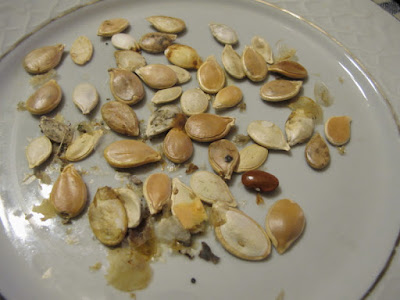
I had a minor little burası Türkiye moment yesterday when I was trading some squash seeds with friends and decided to give in to my inner Pandora and peek into the commercial packet of winter squash seeds I got last fall. The seed packet should have been a hint - packaged in 2004, with a badly focused and printed picture of some sort of pumpkin, and no particular variety indicated. But when I opened it, I got more of a surprise than i expected! Here is part of the contents:


There are no less than two different Cucurbita maxima varieties, as well as some other seeds that look like C. pepo or maybe C. moschata. And a bean.

If I had a huge amount of extra room, I would plant a selection just to see what would come out; some might be good. But I'm not going to do the grunt work of opening up 200 more square feet for unknowns when there is so much dependable seed of such amazing varieties available. If I planted them I'd likely get something like the mix in this picture a friend took in Antalya. There is definitely a C. maxima or two, and several moschatas in various shapes and sizes. The maximas might actually be good; they look like some sort of banana squash. I've had some of the dubious moschatas before in Greece; they tend to be fibrous and watery, but with this much variety who knows? I'll probably chuck them, unless there is someone out there who would like to grow a few mystery squashes.

I'm totally planting the bean though.